
Mohammad Javad Zarif Iran, the JCPOA, the Strait of Hormuz and Regional Security
Mohammad Javad Zarif, 66, is a former Iranian foreign minister who served in the government of the reformist Hassan Rouhani from 2013 to 2021. From 2002 to 2007, he was Iran’s Permanent Representative to the United Nations, and from 1 August 2024 until 2 March 2025 he served as Vice President of Iran before being forced to resign. In 2015, he was one of the principal architects of the Joint Comprehensive Plan of Action (JCPOA), commonly known as the Iran nuclear deal. He is now the founder and president of PAIAB (Possibilities Architects), a non-governmental organisation concerned, among other things, with exploring frameworks for inspiring future possibilities. The group recently established the Middle East Network for Atomic Research and Advancement (MENARAH). He first met Jan Kavan in 2002, when Kavan was President of the United Nations General Assembly.
Dear Minister,
1. You have undoubtedly noticed the widespread wave of solidarity with the Islamic Republic of Iran in many countries, particularly outside Europe, after it became the target of unprecedented aggression by the United States and Israel. This was followed by a significant weakening of Israel’s standing, although that process had already begun earlier with the genocide in Gaza. At the same time, however, a number of governments—unfortunately including some in our region—continue to criticise Iran, the victim of the aggression.
Zarif: We are grateful to the people and politicians who stood by us. As you rightly noted, however, the conduct of governments around the world has been an immense disappointment. United Nations Security Council Resolution 2817 was co-sponsored by 136 UN member states, even though it supported the aggressor and condemned the victim.
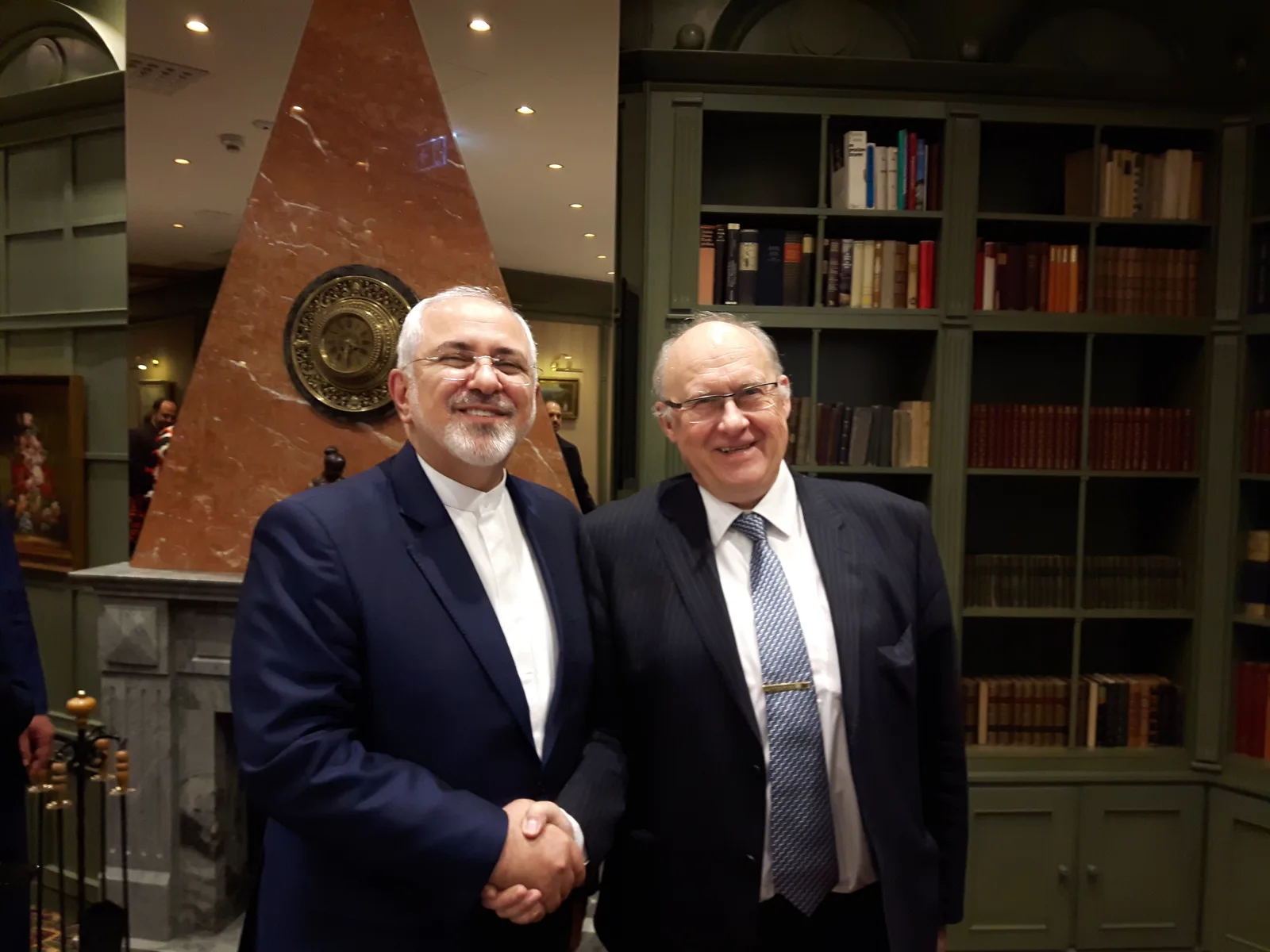
Jan Kavan a Mohammad Džavád Zarif
Jan Kavan a Mohammad Džavád Zarif
2. You were one of the principal architects of the JCPOA nuclear agreement, from which Donald Trump unilaterally withdrew shortly after first becoming President of the United States. At the time, he accused his predecessor, President Obama, of having secured the worst agreement in US history. Paradoxically, President Trump thereby released Iran from any obligation not to continue its nuclear programme. Yet Trump has now proposed an agreement to Iran that, in many respects, clearly resembles the JCPOA. Or is that a mistaken impression?
Zarif: No, you are not mistaken at all. President Trump withdrew from the JCPOA on the false assumption that a policy of maximum pressure would lead to regime change in Iran. In 2017, Netanyahu, Bolton and Pompeo persuaded him of this, and in 2025 Netanyahu did so again—arguing that pressure and military aggression would bring about the fall of the Iranian government. Now that this illusion has proved baseless, he is seeking an agreement that cannot differ greatly from the JCPOA. Indeed, in some respects it is even slightly more favourable to Iran.
3. In your view, how should the Strait of Hormuz operate? Who should control it? Could it, for example, be administered jointly by Iran and Oman, as was partly suggested by the Memorandum of Understanding between the United States and Iran, which Trump subsequently repudiated?
Zarif: I addressed this question in an essay due to be published in the American journal Foreign Affairs. The Memorandum contains a sentence referring to “the need to agree on such arrangements as would best ensure the safe passage of commercial vessels through the Strait, with no charge, for 60 days only.” Iran inferred from this that, together with Oman, it could “agree on the future administration of the Strait of Hormuz” in conjunction with the other Persian Gulf states. The United States, however, believed that Iran had unconditionally accepted toll-free passage through the Strait and that the United States did not have to respect any other Iranian arrangements. The Memorandum could not survive such a disonance. The resumption of military conflict was therefore less of a question of if than of when.
Zarif: Before the war, Iran essentially tolerated a situation in which ships from all countries passed through the Strait of Hormuz without difficulty, even though US sanctions created problems for Iran both in exporting its own goods and in importing the goods it needed. The situation has now changed. Iran is now convinced that no waterways can be politically neutral if they facilitate the transport of weapons systems or logistical support to the United States and its partners while they are attacking Iran. Today, the Strait of Hormuz is viewed primarily through the prism of the state’s existential security. Iran has therefore closed the Strait again. Western analysts explain this as an Iranian attempt to restrict freedom of navigation and damage the global energy market, but that is not true. Iran is merely trying to make it more difficult for the United States to pursue its campaign to destroy Iran.
4. Iran responded to the American bombing by striking US bases in the Persian Gulf states. Some time ago, the international media noted that Iranian President Masoud Pezeshkian—whose election you did much to help secure—strongly objected to this situation because these attacks have caused civilian casualties and damaged infrastructure in neighbouring countries. The Revolutionary Guards rejected his criticism, however, and have continued to bomb bases in neighbouring states. How do you see the future relationship between these states and Iran once a peace agreement has been reached?
Zarif: I believe that war is in no one’s interest. And of course no one in Iran takes pleasure in attacks on neighbouring countries. They are a consequence of wartime circumstances imposed on Iran from the territory of those countries. I recently wrote a detailed essay on this subject as well.
Zarif: In brief, now that the United States has understood that Iran cannot be defeated militarily—because it successfully defended itself against two nuclear powers—a long-term solution for the entire region must be left to diplomacy. I am convinced that Iran and the United States will never again be friends.. The recent wars, in which the United States and Israel murdered Iran’s Supreme Leader and all of its highest-ranking officials, as well as thousands of citizens—including hundreds of young, innocent schoolgirls—have enormously deepened historical wounds and grievances.
Zarif: These deep grievances will not be forgotten or forgiven, but they need not result in continued fighting or escalation. Realistic security arrangements must be found, including a mutual non-aggression pact that would prevent differences over values and identity from once again developing into military confrontation. The United States should recognise Iran’s territorial integrity, strip Iran and its agencies of terrorist designations, and permanently lift all sanctions. Washington should also commit itself to making a significant contribution to the country’s reconstruction after the damage caused to Iran by the aggression by setting up a $300 billion investment fund for the country mentioned in the Memorandum of Understanding.
Zarif: In return, Iran should provide permanent guarantees regarding nuclear non-proliferation. It should also ratify the Additional Protocol of the International Atomic Energy Agency (IAEA), which grants IAEA inspectors additional access to nuclear facilities. It should further incorporate into its domestic law the religious decree, or fatwa, issued by the late Supreme Leader Ayatollah Ali Khamenei, against nuclear weapons.
Zarif: The regional security system as a whole can be stable only if it includes all the principal states of the region and if none of them seeks its own security at the expense of the others. (This corresponds to the current approach of all the Persian Gulf states, perhaps with the exception of the United Arab Emirates—JK.) As vice president in 2024, I called for establishing an institutionalized dialogue among regional states premised on mutual respect, non-intervention, and, eventually, non-aggression arrangements.
Zarif: The security of the Persian Gulf cannot be guaranteed in the long term by outside powers. That would create new security problems, because every new military base, every additional deployment of forces and every new defence system prompts a corresponding response from other states.
The role of Israel cannot be overlooked. Beyond initiating the first war against Iran in June 2025 and persuading Trump to join in starting the second, successive Israeli governments have consistently opposed US initiatives that sought to reduce tensions and stabilize West Asia, including the 2015 nuclear deal. Israel´s behavior not only prevents peace with Iran, it destabilizes all of West Asia. Through its expansion of occupied settlements, its genocide in Gaza, and its devastation of Lebanon, Israel has demonstrated repeatedly that it prefers to sow chaos throughout the region to sustain its military dominance.
5. You served as Iran’s ambassador to the United Nations, and that was when we first met. You therefore know the UN very well. The UN leadership is now being criticised for doing very little to bring this war to an end, just as it has failed to end other current military conflicts around the world. Do you think the next UN Secretary-General could be more effective and successful, despite having to confront the uncompromising position of the United States?
Zarif: I am deeply disappointed with the current UN Secretary-General, António Guterres. I am alarmed by the prospect that Rafael Grossi, the current Director General of the International Atomic Energy Agency (IAEA), might take over the post. Just as at the IAEA—and previously in The Hague—he would be entirely subordinate to the interests of the United States and Israel. Let us hope that the next Secretary-General will be a distinguished woman from Latin America.
(Incidentally, I—JK—personally support María Fernanda Espinosa, a linguist, poet and diplomat from Ecuador who is a former President of the UN General Assembly and a former Minister of Foreign Affairs and Minister of Defence of Ecuador.)
Zarif: Whoever it may be, however, the shadow cast by the United States over the United Nations is paralysing.
Diskuse
Komentáře
K videu: Mohammad Javad Zarif Iran, the JCPOA, the Strait of Hormuz and Regional Security
Join the discussion. Sign-in is free.
Načítám komentáře...