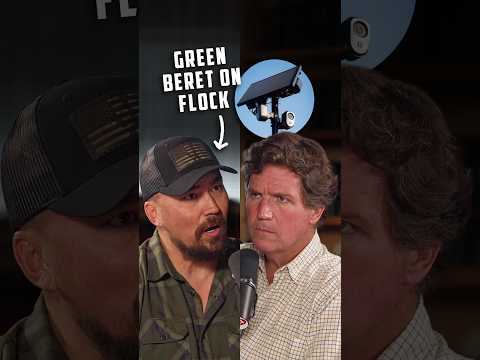
Former Green Beret on Doomsday Prepping, Potential Revolution, and What to Do When Chaos Erupts
Former Green Beret on Doomsday Prepping, Potential Revolution, and What to Do When Chaos Erupts
Přepis videa
Zobrazit / skrýt přepis
Mike Glover, thank you for doing this. Congrats on the book. >> Thank you. >> You made a point. Um, many people talk about preparedness. Some probably not qualified to talk about it. I think you are, but you've made a point I've not heard anybody else make and that is that they're we're clearly witnessing the construction of a much more technologically advanced security and surveillance state in our country. That's clear. but that we need to prepare ourselves in the face of that and I've never heard anybody say that and I think it's a really interesting idea and so I hope you'll explain it in depth but to begin can you describe what's being constructed now and what you think it means >> yeah I think it's it has a lot to do with the incentives that are driving the entire apparatus the institutions all of them are built off of scale growth all these metrics and most of the institutions that are tethered to people have financial incentives and incentives to grow annually from October to October and what I see happening especially with a lot of the institutions >> that's >> yeah they exist um in order to keep you tethered to them so imagine like the the analogy I use is like the umbilical cord everybody is tethered to the umbilical cord I mean you're you're water and your power, for example, are tethered to the system, the infrastructure of the city or town that you live in. If something collapses, there's no contingency for anything independently to happen, right? >> Because the institution supposedly has a contingency plan. Well, what if they don't, right? Um the idea of firefighters and policemen, they they patrol your neighborhoods because you pay taxes and you have buyin, collective buy in that they're going to take care of you. But we understand from catastrophe that, you know, when seconds count, both of those first responders, including EMS professionals, are minutes away. They they they're not going to be there in enough time. if it's the self-defense shooting, if it's the car accident, they're really there picking up the pieces in many cases. And so the idea for me is like I want people to be self-reliant. I just want them to have independence. You know, I have a whale, for example. Not everybody could have a well in their backyard. I get that. But there are other elements to this where you can have independence. Protein from the grocery store. I mean, you go to the grocery store, you buy protein, it's in a nice styrofoam container with cellophane and pink gel. You have no idea where it came from. So, I I want you to insource your dependence and become more self-reliant. Well, if you have an institution that by design in the name of safety, for example, is surveilling you, they're telling you, and now private companies are telling you through the subcontract, they're telling you that we're going to make you safer. And so, you don't need to do anything. And I I actually just connected this dot cuz we were we were having breakfast and I was I was talking about it like I I gave the analogy of like walking to Target, right? I'm walking to a bad guy's house. In some cases, because of the technology integrated, I didn't have to pull security. So, I'm I'm holding a rifle like using my infrared flood light and laser to go around every single bush and tree because I'm like, there's something behind there. The aircraft above me that costs millions of dollars has a fleer pod that could assess heat. And so, there would be the case where it says, "Hey, there's no need to pull security walking to the objective. We got you." and then a guy is buried underneath foilage or palm grove and then he detonates a suicide vest and kills your whole team because you weren't paying attention. So that's the analogy that I I say about this integration of tech. The more it grows, the larger it gets, the more reliant you are on that system and the more your personal safety is actually compromised. >> So So I think there are two insights in what you just said that I hadn't really occurred to me. One, it's the nature of the system like cancer to grow. It just that's that's encoded in the DNA of all of these systems is growth. That's the center of our kind of business model, national business model is scale. >> Mhm. >> So like Flock for example, I I was not even aware Flock existed until fairly recently. What's the growth of Flock been like? >> Yeah. 2017 Flock camera because it's camera. Singler. It was just a camera for an HOA and >> a homeowners association. >> A homeowners association. And the idea was like, let's build this camera. Let's tether solar to it to keep it generated and see how this works. Well, here we are 9 years later in scale. And there's not real good numbers because they don't advertise the numbers, but the estimate today is there's 120,000 flock cameras across the United States. So the intention was like, hey, this neighborhood watch wants to put out a camera because there's some things going on with HOA. And then we scale it. 9 years later, it's 120,000 with billions of reports every single month that take place with license plates and vehicles and descriptions, etc. Now, if you look at that scale as it's kind of like segmented because other companies are getting smart. Like again if I start a company the the point is to scale to grow to compete. So now we have a competing market of flock like camera systems. So in the case of California >> without the damaged brand name >> without the damaged brand name. You know I was thinking about this when I was when I was actually coming here because um every time I drive through my town of Hebrew City, Utah, there are a couple points in town where if you drive through the intersection, you'll drop cell phone reception. And every time I drop cell phone reception, and I'm no signal intelligence or signal communications expert, I drive through the intersection, I see a flock camera as soon as my cell phone drops. And I'm like, I wonder why that is. Maybe it's interference. Maybe it's not even real, but I'm noticing more Flock cameras in my in my area. Well, Flock would only have to change the form factor in the company name. Now, thanks to public outcry and the attention it's deservingly getting, um, it's not likely to do that clandestinely. That's going to be leaked and people are going to talk about it. I'll be talking about it. >> But the the scale that I'm seeing now, for example, in California and Texas is now now there are camera systems operating, for example, looking for violations of code. So imagine you live in a neighborhood, code violations. code violations like you have a RV parked in your driveway and you're not supposed to, right? By the way, like if if anybody's tracking these these stories, um most of the code violations they're finding are happening in impoverished areas where like they don't have an HOA that's managing, you know, pulling up in front of somebody's driveway and saying, "Oh, you have an RV in your parking lot. That's not allowed." And and the guy's like, "Yeah, no problem. I'll just move my RV." Most of it's not RVs. It's damaged fences. It's mailboxes that are ripped down cuz it's all poor neighborhoods. So apparently they found thousands of code violations in a couple days actually bragging about it. Like we found all these code violations and now we can wrangle them in. Okay. It wasn't a problem before, but now now you built the infrastructure to to uh to look at it and assess it. Now it's a big problem. >> You've created a lot more criminals. >> You you've created a lot more criminals. And so it's the idea like the the the idea isn't what's happening now because right now it's like yeah there's problems. Um in fact I have a thesis or theory on what's going to happen but when you look at scale Facebook was designed to be a social interactive way for college students to communicate with one another. >> Now they just settled a lawsuit for like $14 billion for child exploitation. So where have we come in scale? Well, we didn't know we were going to land at child exploitation. We were looking at integrating dorm rooms to be able to communicate with one another. >> So, if we look at scale today and how things evolve >> this year alone actually um 107 different reported there's probably more um situations where flot cameras were damaged. And when you take 107 in some cases dozens of flot cameras are damaged. vandalized. >> Vandalized. So there's reports of this happening because people are upset. >> Yeah. >> How does this evolve? Well, in my personal opinion, I think it evolves where, you know, we think about civil war. I don't think there's going to be a civil war against people because it's not the people that are the problem. It's the institutions, the relationship with people. And when people look at tech, it's a bot. There is no victim. When I take down a a flock camera and destroy it with a baseball bat, there's no victim. I'm doing good. And I'm not advocating for anybody to do this to break the law. But what I'm saying is the scale of how this evolves is rebellion because everything that's being integrated before like Facebook from 2004 to present scaled except we don't need 20 years of scale when you have AI acceleration and then the power I think the benefit and one of the uh powers of social media of advancing information across and disseminating across the globe um you see the potential of mass spikes in this graph whereby um you're going to have a lot of rebellion, insurgency like you've never seen it before, patriotism like you've never seen it before. Fighting the systems that are basically trying to take away humanity in >> You're getting me really excited, Mike Glover. I have to say, [laughter] >> sorry, not that I'm endorsing any. >> It's a thesis. It's a theory. my hypothesis. >> This is best case, let's just say, [laughter] where all of a sudden the country unites, the people unite against the machines. How is that not like utopia? >> They they will. >> Most people don't like thinking about life insurance. It's one of those topics you tend to kind of put off. But if you're married, you've got kids, you've got people who depend on you, you probably should think about what would happen if you weren't around. And that's why we've partnered with Ethos. They've made getting life insurance super easy. You can do the whole thing online. You don't have to sit down with an agent or go through a medical exam. You get a quote in seconds, apply in just a few minutes, and in some cases, you get coverage the same day. You just answer a couple of simple health questions. You get up to $3 million in coverage. Some policies can be yours for as little as 30 bucks a month. So, it's a good deal. If you've been putting off life insurance because you thought it would be a very complicated, expensive process, you should probably check out Ethos. Take a couple of minutes, get your free quote online at ethos.com/tucker. [music] Ethos is ethos.com/tucker. Application times obviously vary as do rates, but we think it's pretty good. >> I I personally think that we're years we're it's happening now. By the way, there's pockets of resistance of people together doing things like, hey, where are the flock cameras? Where are all the systems? Let's surveil the people who are actually doing. And they're not hurting people, >> right? They're just demonstrating that this is wrong and they're combating it because legislatively there is no solution. And that that's my biggest fear, by the way, because I've never been a political guy. I can care less about what's going on in the White House >> because it's not because I I you shouldn't pay attention to what's happening policy wise. You should you should be informed. >> But my reality revolves around my family, my love of God, and my community. The fear I have now is for the first time in my life I'm seeing in Utah, a great state to live in, like one of my f my favorite state because I live there. I love it. I love the people of Utah. But for the first time, I'm seeing people like in Elderbox County or people in Ogden Valley fighting against property tax, fighting against data centers, and the politicians that are appointed elected in those positions aren't listening for the first time. Like I was like, well, obviously when you know for 5 hours people protest and say we don't want this, they're they're they're members of the community that were elected by the people in that community. They're not going to follow through with that. That's my biggest fear because I always tell people like you fight for your faith and your family and your community. I got a shirt that says God, family, prepping in that order. >> Yes. >> And so the fear is now it's like institutionally the federal government doesn't have a lot of impact on your life. It can. I'm a veteran. I do a VA. It does. But the reality is the things that are going on in your backyard are more significant that you should be invested in. And for the first time I'm seeing people combat, argue, legislate, and they're getting crushed. I mean, Ogden Valley's property tax went up 500%. Like what? Like 500%. That's not nominal. That's not like a small number. That's a big number for working families. >> You'll lose your house over that. >> You'll lose your house over that. >> Um and so I I'm seeing that. So when people confronted local legislative, you know, the city council or whomever runs it, the local officials, they just ignored them. Boxer County is a good example. This data center that Kevin Liry >> Yeah. >> um got behind. Look, I I there's I I don't the estimate is wild because it's thousands of data centers, but there's no real like exact number. The estimate is 4 to 5,000. So if we take data centers that exist, the the one that exists, I forget what county it's in Utah that Meta owns, they're like advancing that and making it very large. I'm talking about, you know, it's like I think it's like millions of acres. It's like massive, like massive build. Boxer County, they didn't stop the project after all the outcry of support from the community and the entire state of Utah and really the country that was like, "What are you guys doing?" They're like, "It's in the middle of a field. There's nothing there." But the people of Utah don't want that, so why are you doing it? And they continue to fight it. And I checked in yesterday on this project. I I talk about it nearly every other week on my show on my podcast. And it's still going forward. And you're like, how is that possible? Like, who are the people that are supporting this? Where are they at? Where are their voices at? And what what is their justification? And then you find out there's like backdoor deals and a whole bunch of drama around it. Um and bribery >> and bribery and everything else and and so it it even for me in Hebrew City in Wasach County, which I think is the best county in Utah, um where I live, I'm disconnected from that. But soon you may feel the same. You're like, it doesn't matter because it's down the road or it's across the state or it's in another state. eventually because of the scale, the hypers scale of everything we're doing, it could be in your backyard next week. That flock camera that you talk about and you virtue signal about cuz you're like, "Yeah, screw flock cameras." It's like it might be at the intersection where you live pointed at your house because they do that. They they point them at little girls gymnastics events, which you know the CEO is catching crap for, which he should. And it's like, what are you guys doing? And then when it does populate, what are you going to do? Well, if you're not prepared, you don't have a plan, you're not integrated in your community cuz you're just kind of checked out. Well, that's that's a problem because all your self-reliance that you've outsourced so easily is is going to be affected and impact. So that's the second insight that really struck me uh in your thesis, which is that technology is not simply a threat because of what it might do to you, what it might compel you to do or prevent you from doing. It's a threat because it weakens you. >> Yes. >> Because you become reliant on it. >> It's it's like the Google Map program, >> you know, and you just like use that for 10 years and see if you know where you are. Mhm. And I mentioned this to you before. We were talking about this at breakfast and you're the greatest line ever. You said after using Google Maps, you'll just like follow the line they give you under a sidewalk. You you'll drive to a shopping mall cuz you're just following it. >> It says there's the line [laughter] there. And it's it's it's true. I mean, if you if you think about it from this perspective, my my experience is obviously the military. Uh I was in special operations and I was a sniper at one point. uh when I was a team sergeant had a a group full of a team full of like rock stars, right? And they were all independently schooled in sniper operations. They had to go to special forces sniper course, which used to be called SODIC, special operations target interdiction course. uh Delta snipers, um special forces snipers, Ranger snipers in some cases go to this schoolhouse to be qualified. All my guys were qualified and meaning they were very competent in sniper operations. They knew how to use a a sniper weapon system. At one point, for some reason, and likely it came top down, I was told, "Hey, we want to put a camera in your optic." And I was like, "For what?" Like, "Why do you why do you want a camera in the optic?" It's like, "Oh, we want to be able to see it. There's this technology and it integrates into the tactical operations center and we could see it." And then I'm like, "Yeah, but I'm on comms. So, if you think you're going to micromanage my snipers through a camera with communications, there's latency there. And one, it's no, but two, I don't want this to ever happen. I don't want uh my sniper to second guessess his actions because >> he's being viewed for a viewfinder. And because you don't like something you see, you try to communicate, let's not do that. That latency will get my sniper killed. like let's not do that and then it never happened. But that's an example of how this integration always works. I mean that here's a here's a great example the health care system right the health care system buyin is that if you want to get through a difficult circumstance a bacterial infection a stomach ache that requires I don't know penicellin you have to go through a process an entire system so our grandmothers our fathers might have taught us about holistic medicine like independency That's what it was actually. Holistic medicine was just a requirement because it was life uh 100 years ago. It was you had to be resilient because it was just life, right? >> There was no pharma. >> There was there was no there was no big pharma. There was no big health care systems. You had to take care of yourself and your family. You had to figure it out. >> So when you look at for example the health care system, I actually just heard this last night flying here. Um, the third leading cause of death, according to this podcast between Huberman and Rogan, which is a great podcast by the way, dropped yesterday. That podcast, they talked about a number of how many people were killed because of medical malpractice, died because of medical malpractice. In one year, 251,000 people according to >> Americans. >> Americans, >> a quarter million Americans died in one year because of quart million Americans according to again you guys could look this up according to the statistic they pulled up by John Hopkins >> and I'm like okay and then I I was asking the question in my head where does that rank in leading causes of death but that's like a that's a city that that's a city that's top three that's actually the third leading cause of death if it was actually reported but it's not reported because John Hopkins had to do the independent survey to look at the statistics but if you integrate it it's right behind cardiovascular or or basically you know any cardiovascular disease which is the main killer in America and cancer I think it would be lower respiratory disease would be in the third place slot if it wasn't for 250 plus thousand people dying because of medical malpractice and error >> which is wild right so think about the efficiency of the systems we depend on if you knew that you went into a hospital late at night and they talked about this they articulated this when a doctor has been on shift for 12 hours, which is he's technically drunk when he's on shift for 12 hours. I mean, you can't drive in some cases because you're so impaired. I mean, so he's making decisions, life or death decisions. And 250 plus thousand people, 250 1,000 people apparently die every year because of it. So again, the institution is meant to protect you in the name of safety, national security, whatever it may be. But the reality is because institutions which I I like this idea. Men are sinners. Every man is a sinner. We all fall for fall short. When you align that into an institution according to the Bible, the the institution is for good. You're supposed to have it for good. The government is for good. But what it does I don't think I don't think institutions are evil. I think people are inherently flawed. And I have no other expectation that they're not. And then eventually the truth reveals itself. Yes. So all these institutions that we hope the best for like many of my good friends say hope is not a course of action. Eventually the truth reveals itself and they're broken. Now the problem is what what do we do with broke system broken systems? That's another question. But the reality is the dependency you have on these systems across every single facet of the umbilical cord connected is failing. So maybe the better analogy is like the umbilical cord is connected to the mom who just started smoking crack. And if you want to prolong this, >> yeah, we know what that looks like. We know the outcome. So you need to cut the umbilical cord and you need to start insourcing your own reliance in order to survive. And and I and I say that and I mean it. I mean survive because more of your dependency where people go, "Well, Mike, you just call 911." Yeah, but you'd be dead. Yeah, but what else would I do? Oh, that's where our conversation on preparedness started. >> I mean, I feel like we should have learned this during COVID. We probably should have learned it during Hurricane Katrina, you know, 21 years ago. You know, natural disaster occurs in a major American city and the people whose job it is to help you just melt away because they've got their own family problems. >> Yeah. >> So, most of the snacks you could buy at your local corporate grocery store are not real food at all. All they're made of weird chemicals, kinds of ingredients you can pronounce. You don't want to put that in your body. All those dyes, red 40, yellow five, no thanks. Grass-fed beef sticks from Paleo Valley are totally different. Unlike most beef sticks, they are completely natural and entirely free of something called encapsulated citric acid. Zero encapsulated citric [music] acid. Paleo values is oldworld natural fermentation. That's a method that people have used for centuries. And that means what you eat is totally real. It's healthy. Tastes good. No sugar, soy, nitrates, or any of the stuff you'll find at gas station meat sticks. It's quick, it's easy, and it's good for you. The original flavor is our favorite. It's seasoned perfectly. Throw a few Paleo Valley beef sticks in your bag, in your glove box, and desk drawer whenever you need protein quickly. It's worth it. paleo valley.com/tucker. Use the code Tucker at checkout for 20% off your order. paleo valley.com/tucker code Tucker at checkout 20% off. So, but anyway, but certainly COVID where if you followed the official guidance, your chance of dying went up obviously um or of permanent injury went up. So, we're now on the cusp of technological change. It's like the one thing we know about it, it's going to empower those systems. It's going to make them give them more control than they currently have. So, what do you what do you like how do you prepare? How do you become more self-reliant in the face of that? >> Well, I think the the easiest way to kind of start it is have a conversation with your family, your the ones you love, and and actually circumn a deliberate intentional plan to disconnect. Um, and look, I I I started teaching modern survival. I'm not a primitive survival expert. I I joke about it. It's like I'm not going to teach you to survive when you're naked and afraid in the woods because if you're naked and afraid in the woods, you've made a lot of mistakes, right? You you've [laughter] screwed up. >> Why are you naked in the woods? That's a fair, you know, that's a totally fair question, Mike. >> Yeah. So, everybody thinks survival is like the naked and afraid show and all these things. It's like survival for me is like the modern take on it. >> Well, if you're naked in the woods alone, it's also weird. >> It's also weird. Yeah. >> There's a lot of things that can get you. Um, and so I I don't I look at that and I go, look, a modern survival take on this is you need to look at all the institutions you're tethered to and figure out ways to start uh segmenting yourself away from them and building your dependency. I mean, it's why I advocate, for example, for homeschool. I mean, my kids right now are in a great school uh in the public education system in Utah for elementary school, but when they get through the basics of arithmetic and everything else and they're advancing into social studies, I don't want them learning about things that I want them learning about. So, I I'd like to homeschool them. Um, we talked about protein. If if you don't if you if you don't insource your protein and there's any infrastructure threats whatsoever, which there are all the time. I mean, diesel's higher than it's ever been, the infrastructure could have one impact or catastrophe and the entire apparatus shuts down. I I talk about this every week on Survival Dispatch uh with a group of guys who are experts at this and the the general consensus is that one little thing can affect the outcome of all the things that you're tethered to. So the Walmart down the road has a couple weeks of supply. What happens when everybody goes, we learned this from CO, and gets everything off the shelf? It's empty. What happens if the the truck that's driving down, they strike um the war in Iran accelerates and that entire apparatus gets cut off, then you don't have any food. If you don't hunt, if you don't know how to hunt, if you've never gone fishing, if you haven't insourced anything, maybe it's a good time to like sit down and have the conversation with your family and just start there with some basics. It's not that complicated. You mentioned homeschooling at first. So that's a lot that's a much more complex system than say getting protein. Like you could stockpile >> conceivably a year's worth of protein in your garage. It's not that hard. You could buy it on Amazon. But you're thinking about separating yourself from like a pretty basic system like education. Public education. >> Yeah. Public education is is an easy one because we know all the drama that's happened over the last few years, especially with co even with co California, they destroyed these kids um likely long term because they kept them out of schools and social settings >> and kept them isolated. I mean like basically putting your children in solitary actually putting somebody else's children in solitary environment. >> U and we know that that's having long-term effects on our public education system is garbage. It's disgusting. I mea
Zobrazena první část přepisu (28 000 z 88 719 znaků).